
It is 9:40 on a Sunday night in late June. A homeowner notices the upstairs vents blowing warm air, finds your site through a Google ad and taps “Request service”. The form asks for eleven things, including the equipment model number, and she gives up at field seven. Across town, her neighbor fills in a four-line form on a competitor’s site and gets a text back before she puts her phone down. That is where most HVAC website leads go missing: in the gaps between the form, the phone and the follow-up.
Even when your office calls back on Monday morning, the odds are poor. Hiya’s State of the Call 2026 report, based on a survey of more than 12,000 consumers in six countries, found 86% of people won’t answer a call from an unidentified number. Here is how to join your forms, calls and follow-up into one automated system that replies within a minute, from a number she knows.
HVAC website leads by the numbers
| Statistic | What it means for HVAC companies | Source + year |
|---|---|---|
| Home improvement landing pages convert at a median of 2.6%; the top quarter convert at 19.5% | The same traffic can yield far more requests on a better page | Unbounce Conversion Benchmark Report, 2024 |
| Pages that mix clicks, forms and calls convert at 4% | Offer a short form and tap-to-call side by side | Unbounce, 2024 |
| HVAC search ads convert at 15.11%, at an average cost per click of $9.49 | Every paid form and call needs a fast answer | LocalIQ benchmarks via CallRail, 2026 |
| 44% of respondents named a phone number as their top-performing call to action | Bury the number and you lose your best converter | Scorpion survey via CallRail, 2026 |
| 86% won’t answer unidentified calls; 73% want businesses to show their name on caller ID | Callbacks from an unknown number mostly go unanswered | Hiya State of the Call, 2026 |
| 54% of consumers visit a business’s website after reading a positive review | Reviews send people to your site, and the site has to capture them | BrightLocal Local Consumer Review Survey, 2026 |
| 61% of callers reach a person, and 35% of agents ask the caller to buy or book | Answered calls still leak when nobody asks for the appointment | Invoca Call Conversion Benchmarks, 2025 |
Where HVAC website leads get lost
BrightLocal’s 2026 Local Consumer Review Survey found 54% of consumers visit a business’s website after reading a positive review. In our audits of home-service clients, those visitors slip through three small gaps.
The form asks for too much
Many HVAC forms ask for model number, system age, preferred technician and how you heard about us. Each field is one more reason to quit on a phone. Unbounce’s 2024 benchmark of 4,372 home improvement landing pages put the median conversion rate at 2.6%, while the top 25% reached 19.5%. For HVAC pages, those under 200 words did best.
Calls and forms land in different places
Form alerts go to a shared inbox, calls to a desk phone or the owner’s cell, and chat messages to a plugin nobody checks on weekends. The same homeowner might fill in the form and then call 20 minutes later. Without one CRM record, two people call her back, or nobody does because each assumes the other has it.
The callback comes from a number she doesn’t know
When the office finally calls, it often uses a cell that isn’t the number on the website. Hiya’s 2026 survey found 41% of people let unidentified calls ring out to see if a voicemail arrives, and 28% reject them on sight.
How to automate HVAC website leads, step by step
This is our build for HVAC companies with one to five trucks. It runs in a CRM such as GoHighLevel and keeps your website, phone number and dispatch software.
Step 1: Cut the service form to five fields and add tap-to-call
These five fields cover almost every residential request:
- Name
- Mobile number
- ZIP code, so the CRM can check your service area
- What’s wrong, as a dropdown: no cooling, no heat, noise or leak, tune-up, new system quote
- An optional notes box
Collect equipment details later by text. On mobile, put a tap-to-call button beside the form. Unbounce found home improvement pages that offer clicks, forms and calls together convert at 4%, and in a Scorpion survey cited by CallRail’s 2026 home services statistics, 44% of respondents named the phone number as their best-performing call to action.
Step 2: Send every form into the CRM the moment it arrives
If the form is built in GoHighLevel, the Form Submitted workflow trigger fires on each submission. For WordPress or Webflow forms, send each entry to the CRM with a webhook or an n8n workflow. It should search for an existing contact by phone and email, then create or update one record with the source, problem and ZIP code.
Step 3: Track calls with a number for each source
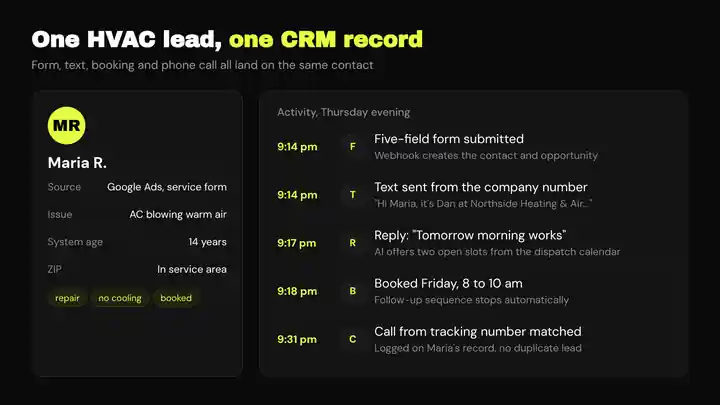
Call tracking gives each channel (Google Ads, your Google Business Profile, organic search) its own number and swaps the number on the website based on how the visitor arrived. When the homeowner who filled in the form rings 20 minutes later, the CRM matches her phone number and adds the call recording to the same record. You also see which ad produced it.
Step 4: Reply within a minute, from a number she recognizes
The first text should go out within 60 seconds of the form, from the number printed on your website and trucks, signed by a real person: “Hi Maria, it’s Dan at Northside Heating & Air. Got your request about warm air upstairs. Is anyone at home elderly or unwell, or can this wait until tomorrow morning?” An AI chatbot then handles replies and offers two open slots from your dispatch calendar.
Set up branded caller ID with your phone provider where it’s offered. Hiya reports 73% of consumers want businesses to identify themselves this way. US texting numbers also need A2P 10DLC registration.
Step 5: Run a seven-day follow-up that stops when they book
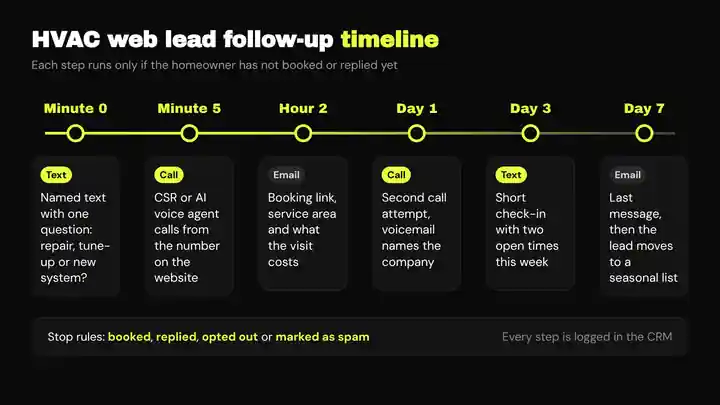
A homeowner who ignores the first text is usually busy, not gone, so the sequence below keeps trying for a week and stops the moment they respond. Each call should end with two specific times: Invoca’s 2025 call benchmarks, drawn from more than 60 million calls, found only 35% of agents ask callers to buy or book. For estimate reminders and longer nurture, see our post on AI lead follow-up automation for HVAC companies.
| Trigger | What the CRM does | Stop rule |
|---|---|---|
| Form submitted | Named text within 60 seconds; AI chatbot handles replies | Homeowner replies or books |
| No reply after 5 minutes | Call task for the CSR, or an AI voice agent calls from the main number | Call connects |
| Tracked call from a new number | Contact created, recording and summary attached, CSR alerted | Booked on the call |
| No booking after 2 hours | Email with booking link, service area and diagnostic fee | Booked online |
| Still silent on day 1, 3 and 7 | Second call, short text with two open times, final email | Booked, replied, opted out or marked as spam |
For unanswered calls, see turning missed HVAC calls into booked appointments. To score leads once they share one record, read about AI lead qualification for HVAC.
What does HVAC lead automation cost?
Plans on GoHighLevel’s pricing page run $97, $297 or $497 per month, and calls, SMS, email and AI are metered separately. Call tracking adds a monthly fee plus per-number and per-minute charges. Confirm current rates before you budget.
Compare that with ad spend. LocalIQ’s benchmarks, reported by CallRail, put the average HVAC search click at $9.49 in 2026. A lead that never hears back is a paid click someone else books. Staff are scarce too: the US Bureau of Labor Statistics projects about 40,600 HVAC mechanic and installer openings a year through 2035. For a single-location shop, our builds take two to three weeks: the form, CRM and text-back in week one, then call tracking, the AI chatbot and testing on live leads.
Where HVAC lead automation goes wrong
- Texting from a number the homeowner has never seen. Use the website number, or replies drop and carriers are more likely to filter you.
- Leaving old form plugins live. A second form on the contact page that still emails the owner means some leads never reach the CRM.
- No duplicate check. Search by phone and email before creating a contact, or one homeowner becomes three leads and gets three texts.
- Letting the chatbot quote system prices. It can share your diagnostic fee and book a visit; replacement numbers come from a comfort advisor.
- Skipping consent. Add an SMS consent checkbox to the form and honor STOP replies straight away.
Frequently asked questions
How many fields should an HVAC service request form have?
Five is enough for most HVAC companies: name, mobile number, ZIP code, the problem from a short dropdown and an optional notes box. Collect equipment age, model and access details by text or on the booking call. Fewer fields mean more finished forms on phones, which is where most urgent repair requests start.
Should an HVAC company replace its contact form with a chatbot?
Keep both. A short form suits homeowners who already know what they need, while an AI chatbot helps people with questions about service areas, fees or timing. Both should write to the same CRM record and start the same follow-up, so it makes no difference which one the homeowner uses first.
Why do homeowners ignore our callbacks?
Usually because they don’t recognize the number. Hiya’s State of the Call 2026 survey found 86% of consumers won’t answer unidentified calls. Call back from the number shown on your website, send a named text first so they expect you, and register branded caller ID wherever your carrier or phone provider offers it.
What should we measure after automating website leads?
Track four numbers every week: minutes from form to first reply, the share of form and call leads that book, booked jobs by source, and leads still uncontacted after 24 hours. Your CRM and call tracking can report all four. If first replies land within a minute and uncontacted leads keep falling, the system is doing its job.
Your first week
Tonight, fill in your own service form on your phone. Count the fields, time the reply and note which number calls you. That ten-minute test shows where your HVAC website leads slip away.
Cubikey builds this system for HVAC companies: short-form landing pages, GoHighLevel workflows, call tracking, AI chatbots and voice agents, and the integrations that push booked jobs into your dispatch software. Our AI automation team can review your current form and call setup with you. Talk to Cubikey.
Sources
- Hiya: Eroding trust is crippling the voice channel, State of the Call 2026 (April 2026)
- Unbounce: Conversion Benchmark Report, home improvement industry (2024)
- CallRail: 31 home services marketing statistics, citing LocalIQ and Scorpion (March 2026)
- BrightLocal: Local Consumer Review Survey (2026)
- Plumbing & Mechanical: Invoca Call Conversion Industry Benchmarks Report coverage (June 2025)
- US Bureau of Labor Statistics: Occupational Outlook Handbook, heating, air conditioning and refrigeration mechanics and installers (2026)
- HighLevel Help Center: Workflow Trigger, Form Submitted
- GoHighLevel: Pricing