

At 8:15 on a Sunday night, a homeowner fills in the valuation form on a real estate team’s website and types one line in the comments box: “Can someone walk through the house this week? We want to list before March.” The team’s inside sales agent (ISA) went home at 6. The lead sits in the CRM until the Monday call block, and by then the homeowner has booked a walk-through with the agent who texted back first.
An AI appointment setter closes that gap. It replies within a minute, asks the questions your ISA would ask and puts a confirmed time on the right agent’s calendar. In CallRail’s 2026 survey of more than 700 real estate professionals, only 41% said they respond immediately to after-hours inquiries. This is how we build an AI appointment setter for real estate leads, what it should hand back to people, and what it costs.
Real estate appointment setting by the numbers
| Statistic | What it means for real estate teams | Source + year |
|---|---|---|
| 90% of buyers used an agent or broker, the highest share in four decades | Buyers still hire agents; the setter’s job is getting them in front of yours | NAR Profile of Home Buyers and Sellers, 2026 |
| 92% of sellers used an agent, an all-time high | Listing appointments are worth answering on a Sunday night | NAR Profile of Home Buyers and Sellers, 2026 |
| 74% of buyers value an agent who sends property info by text; 73% value personal update calls | Book by text, then make sure a person calls | NAR 2026 Profile, as reported by BAM, 2026 |
| 67% of surveyed real estate professionals say responsiveness is now tied with price as the top reason a customer picks a business | Speed is part of what you sell | CallRail 2026 Marketing Outlook for Real Estate, via NAHB, 2026 |
| Only 41% respond immediately to after-hours inquiries | Evenings and weekends are mostly uncovered | CallRail, 2026 |
| $60,482 average yearly salary for a real estate inside sales agent | The cost an AI setter gets compared with | Salary.com, November 2026 |
| 33.7% fewer missed appointments after rewritten SMS reminders | Reminders protect bookings you already made | NSW Behavioural Insights Unit, 2021 |
What an AI appointment setter does, and what it hands back
Its one job is turning a new lead into a confirmed calendar slot. A real estate team has three appointment types, each with its own rules.
Buyer consultations
A 20 to 30 minute call or office meeting before any tours. The setter books one when a buyer is pre-approved or wants to start touring within 90 days, and puts the lender’s name in the notes if the buyer gives it.
Showings
Tied to one address. The setter checks the listing is still active, offers slots that respect the seller’s showing instructions and books the agent who covers that area. Our post on capturing real estate website leads with AI covers how the inquiry reaches the CRM in the first place.
Listing appointments
The booking worth the most. The setter collects the address, timeline and reason for selling, then books a 60-minute slot with enough notice for the agent to pull a CMA.
What stays with people: pricing opinions, commission, offers, anything about schools or who lives in a neighborhood (a fair housing risk), and any lead who asks for a human. The last step of every conversation is a handoff.
How to build an AI appointment setter for real estate leads
We build most of these on GoHighLevel, because its Conversation AI and Voice AI book straight into its own calendars. Follow Up Boss or Lofty work too, with an outside AI agent connected through webhooks or n8n.
Step 1: Create one calendar per appointment type
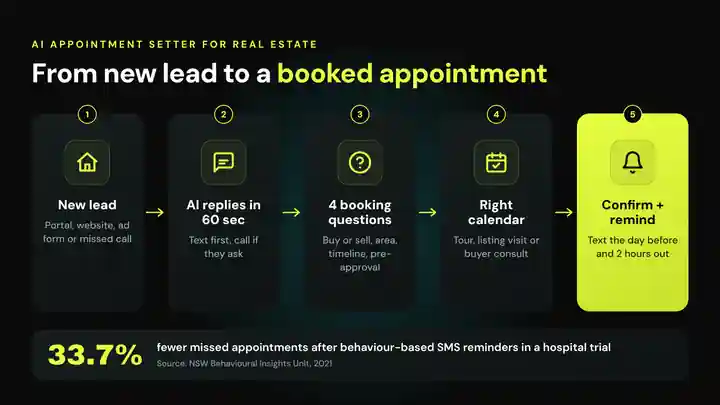
Before switching on any AI, set up separate calendars for buyer consults, showings and listing appointments, each with its own length, buffer, minimum notice and daily cap. HighLevel’s help article on appointment booking in Conversation AI says prompt-based bots can book across multiple calendars, each with a description and trigger keywords, while guided and flow-builder bots support a single calendar.
Step 2: Write four booking questions
The setter needs four answers before it offers a time. It asks them one at a time, in plain words:
- Are you buying, selling, or both?
- Which area or address is this about?
- When are you hoping to move?
- Buyers: have you talked to a lender yet? Sellers: is the home lived in or empty?
Answers are saved to CRM fields so routing rules can read them. A seller who says “next spring” still gets offered a listing appointment, since the agent can price and prepare the home months ahead.
Step 3: Route each booking to the right agent
Routing is where most setups break. We use three rules: area (ZIP code to agent), appointment type (buyer agents take consults and tours, the team lead takes listings) and round robin inside each group. If the contact already has an assigned agent, the setter books that agent only. The prompt structure we use for these rules is in our walkthrough of a lead-qualifying booking agent.
Step 4: Confirm, remind and recover no-shows
The calendar sends a confirmation text right away, a reminder the day before and another two hours out, each with a reschedule link. Wording matters: the NSW Behavioural Insights Unit cut missed hospital appointments by 33.7% in a 2021 trial by rewriting SMS reminders to say what a missed slot costs. For a tour, that can be one line: “The sellers are leaving the house for this visit.”
After a no-show, the setter texts within 15 minutes with two new slots.
Step 5: Add a voice agent for leads who call
HighLevel’s Voice AI booking guide describes the agent booking during a live call against the same calendar rules (availability, buffers, minimum notice), and it can ask for a missing email before confirming. It should say it is the team’s assistant and transfer anyone who asks for a person.
Should an AI appointment setter replace your ISA?
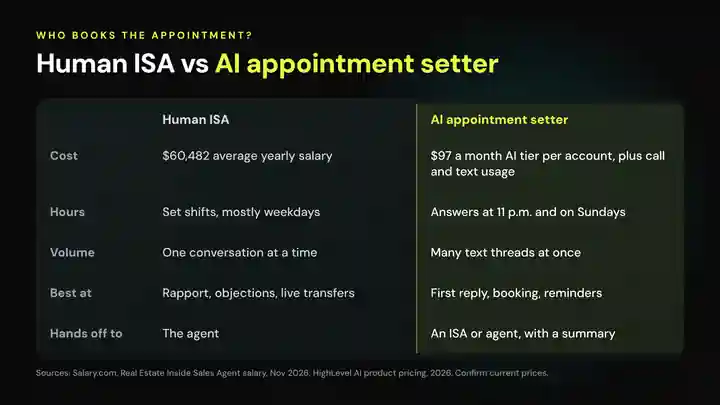
Usually not. Salary.com puts the average US salary for a real estate inside sales agent at $60,482 a year as of November 2026, before bonuses. HighLevel’s AI product pricing page shows two AI plans per account: Growth at $50 a month, which includes 1,000 Conversation AI replies and 100 Voice AI minutes, and Unlimited at $97 a month under fair use. Calls and texts cost extra; check your account for current prices.
The jobs are different. An ISA is good at the second conversation: the seller unsure about timing, the buyer who needs a push. The AI is better at the 11 p.m. first reply, at booking and at sending every reminder on time. NAR’s 2026 buyer data, as reported by BAM, shows buyers value both texts (74%) and personal calls (73%) from their agent. On teams with an ISA, we let the AI book and have the ISA phone every new listing appointment to confirm it.
Where real estate appointment setters go wrong
- Tours booked on homes already under contract. A setter reading a listing feed that refreshes once a day will offer times on pending homes.
- One calendar for everything. A 15-minute showing and a 60-minute listing appointment cannot share rules, and agents end up double-booked.
- No human check on listing appointments. A wrong address costs an agent an evening; confirm by phone within a few hours.
- Robocall rules ignored. The FCC ruled in February 2024 that AI-generated voices count as artificial under the Telephone Consumer Protection Act, so outbound AI calls need the same prior consent as prerecorded ones. Ask your counsel how this applies to each lead source.
- Steering. The setter talks about homes and logistics, never about who lives in an area. Read transcripts every week for the first month.
Frequently asked questions
Can an AI appointment setter book directly into my agents’ calendars?
Yes, if the CRM calendar is the one your agents trust. In GoHighLevel, Conversation AI and Voice AI book against availability, buffers and minimum notice, and connected Google or Outlook calendars block busy times. Agents who keep personal events in a separate calendar need to connect it, or the setter may book over a school pickup.
What does an AI appointment setter cost for a real estate team?
HighLevel lists its AI tiers at $50 or $97 per month per account, on top of the CRM subscription and call and text usage. Setup is the bigger cost: calendars, routing rules, prompts and testing with real leads. For a team of five to fifteen agents, our build usually takes two to three weeks from kickoff to go-live.
Will leads know they are talking to AI?
They should, and in our builds they do. The setter introduces itself as the team’s assistant in its first message and hands over to an agent whenever someone asks. Leads mostly care about a quick answer and a real time slot. Hiding the AI backfires when the agent arrives and the lead works it out.
What happens when a lead asks something the AI cannot answer?
It says it will check with the agent, flags the conversation for a person and sends the agent a short summary with the question. Pricing strategy, offers, commission and school questions always go this way. The lead still gets offered a time, so the booking does not stall while the agent catches up.
Start with your after-hours leads
Pull last month’s leads that came in after 6 p.m. or on weekends, and note how long each waited for a reply and how many booked. That is your baseline. Run the setter on those hours first, keep your ISA or agents on daytime leads, and compare after 30 days. Leads who do not book move into the nurture tracks in our real estate follow-up guide for GoHighLevel.
Cubikey builds this system for real estate teams and brokerages: calendars per appointment type, AI text and voice booking, agent routing, reminders and no-show recovery inside your CRM. See what our AI automation service covers. Talk to Cubikey.
Sources
- National Association of Realtors: Top 10 takeaways from NAR’s 2026 Profile of Home Buyers and Sellers (November 2026)
- BAM: 73% of buyers value personal phone calls from their agent, citing NAR’s 2026 Profile (November 2026)
- NAHB (sponsored by CallRail): What 700+ real estate pros say about marketing in 2026 (January 2026)
- Salary.com: Real Estate Inside Sales Agent salary (November 2026)
- NSW Behavioural Insights Unit: Using behaviourally-informed reminders cuts missed hospital appointments by more than a third (2021)
- HighLevel Help Center: Appointment booking in Conversation AI (October 2026)
- HighLevel Help Center: Appointment booking in Voice AI (September 2026)
- HighLevel Help Center: AI product pricing (November 2026)
- Federal Communications Commission: FCC makes AI-generated voices in robocalls illegal (February 2024)