
A homeowner in Phoenix finds water pooling under the kitchen sink at 7:15 on a Tuesday evening. She fills in the quote form on three plumbing websites and goes back to the towels. The company that texts back first is the one she lets in the door. The minutes between a lead arriving and the first real reply are what home-service owners call speed to lead, and it is the cheapest number in the business to fix.
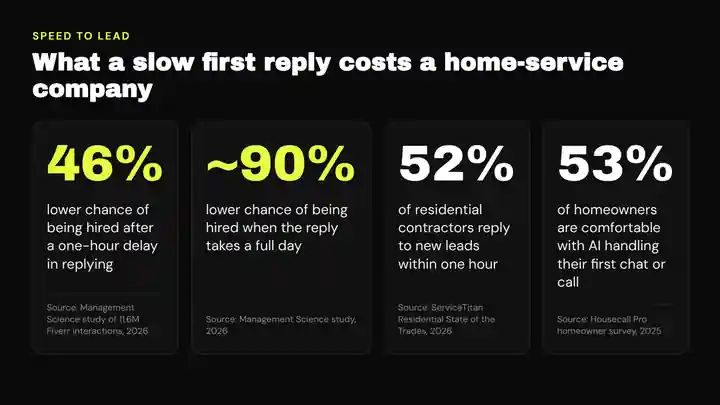
The research on delay is blunt. A 2026 study in Management Science, which analysed 11.6 million interactions on the Fiverr marketplace, found a one-hour delay in replying cut the chance of being hired by 46%, and a full-day delay cut it by roughly 90%, according to UC San Diego. Fiverr is not plumbing, but in our experience the pattern holds for anyone with a leak or a dead outlet. Here is how we automate a home-service company’s first reply so it lands inside a minute, at any hour.
Home-service speed to lead in numbers
| Statistic | What it means for home-service companies | Source + year |
|---|---|---|
| 46% lower chance of being hired after a one-hour reply delay | A callback after lunch has already lost close to half its odds | Amir, Hart, VanEpps and Sezer, Management Science, 2026 |
| About 90% lower chance of being hired after a one-day delay | A Monday reply to a Saturday lead is close to worthless | Management Science, 2026 |
| Only 52% of residential contractors get back to a new lead inside an hour | Replying within the hour only keeps you level with half the market | ServiceTitan Residential State of the Trades, 2026 |
| 58% of homeowners call a pro because of a sudden issue | Most jobs start as an urgent problem the customer wants gone today | Housecall Pro State of Home Service Spending, 2026 |
| 72% would pay more to have the problem fixed within 24 hours | Fast response supports your price instead of cutting into it | Housecall Pro, 2026 |
| 53% of homeowners are comfortable with AI handling their first chat or call | An AI first response is acceptable to most customers | Housecall Pro homeowner survey, 2025 |
Why home-service leads go cold so fast
Leads arrive from six places at once
A typical plumbing or electrical company gets leads from its website form, phone calls, Google Local Services Ads, Angi or Thumbtack, Facebook messages and web chat. Each lands in a different inbox or app. The office manager checks them between dispatch calls, so a form that arrives at 10:05 might be read at 11:20.
The people who answer are also doing the work
In a three-truck shop, the owner is often the closer and the backup technician. When he is in a crawl space, nobody reads Angi notifications. A 2026 ServiceTitan survey of residential contractors, reported by ACHR News, found only about half reply to a new lead within an hour.
Evening and weekend leads wait until morning
Housecall Pro’s State of Home Service Spending 2026 survey of more than 1,100 US households found 58% call a pro because of a sudden issue. A burst pipe at 9 p.m. does not wait for office hours, and 72% said they would pay more to have the problem resolved within 24 hours.
How to automate speed to lead with AI, step by step
We build this for companies with one to ten trucks, usually on GoHighLevel, placed in front of the field service software they already use: Housecall Pro, Jobber or ServiceTitan.
Step 1: Route every lead source into one CRM
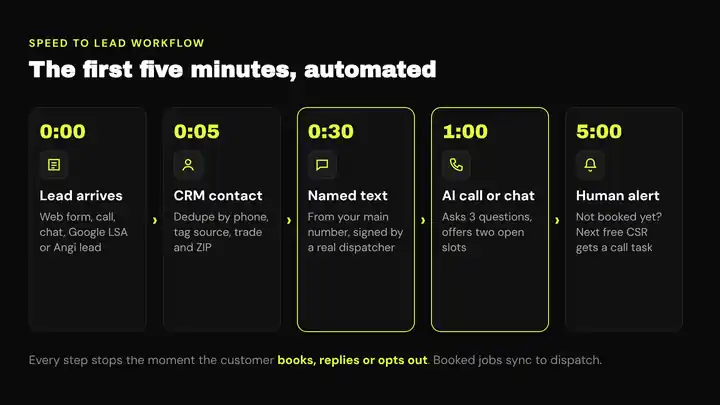
Website forms post in directly or through a webhook, calls arrive through tracking numbers, and chat and Facebook messages land in the CRM’s shared inbox. Angi, Thumbtack and Local Services Ads leads come through an integration or a notification email parsed by an n8n workflow. Match on phone number so a homeowner who fills in a form and then calls is one record, and tag source, trade and ZIP code. Our guide to turning roofing website visitors into leads covers the form side.
Step 2: Send a named text within 30 seconds
The first reply goes out by text from your main business number: “Hi Jason, Carla here from Ridgeline Plumbing. Got your note about the leak under the sink. Is water still running, or were you able to shut the valve?” In our campaigns, a question that takes a one-word answer gets more replies than a booking link.
Your dispatcher writes the template, it goes out in her name, and she sees every reply. That matters: the study’s authors found quick replies lost their appeal when recipients believed they were automated, per the UC San Diego summary. US business texting also needs A2P 10DLC registration.
Step 3: Let an AI agent qualify and offer two times
When the homeowner replies, an AI chatbot introduces itself as the company’s assistant and asks three things: what is wrong, the address, and how urgent it is. Then it offers two open slots from the dispatch calendar. If the lead came in as an unanswered call, an AI voice agent picks up or calls back within a minute and asks the same questions. Housecall Pro’s 2025 survey of 1,040 US homeowners found 53% are comfortable with AI handling their initial chat or phone call. Keep the AI away from job prices; it can share the service call fee and book the visit.
Step 4: Escalate to a human at five minutes
If the lead has not booked or replied within five minutes, the CRM creates a call task for the next available CSR and sends a push alert. Use round-robin assignment in office hours. After hours, anything tagged urgent (active leak, no power, a garage door stuck open) rings the on-call phone. A lead still untouched at 15 minutes alerts the owner.
Step 5: Follow up for seven days, then stop
If the homeowner goes quiet, the sequence we use:
- Hour 2: a short email with your service area, service call fee and a booking link
- Day 1: a second text offering two specific times
- Day 3: an AI voice agent call from the main number
- Day 7: a last text asking whether they still need help, then a move to a monthly list
Every step stops the moment the homeowner books, replies STOP or a CSR marks the lead as lost. Our post on removing manual lead follow-up with AI CRM automation covers longer sequences and reactivation.
How do you measure speed to lead?
Measure minutes from lead creation to the first two-way exchange, not to the auto-text. Each Monday, report the median by source, booking rate by source, and leads with no contact after 24 hours. In GoHighLevel a workflow stamps a date field on the first inbound reply or connected call; elsewhere an n8n workflow can do it.
What does speed-to-lead automation cost?
On GoHighLevel, AI is priced on top of the CRM plan. The cheapest AI tier on HighLevel’s AI pricing page, updated in November 2026, costs $50 a month per location and includes 100 minutes of Voice AI and 1,000 chat or text replies. The unlimited tier is $97 a month, subject to fair use. Phone minutes and texts are metered separately. Prices change often, so check them in your account before you budget.
Adoption is moving: Housecall Pro’s AI in the Trades report, a directional survey of 248 pros, found 48% use AI, and 40% of those users say it helps them respond faster and lose fewer leads. For a single-location company, our build takes two to three weeks, including a week of supervised live leads.
Where speed-to-lead automation goes wrong
- Counting the auto-text as the response. A ten-second text followed by a two-hour silence still leaves the homeowner waiting.
- Messages that read like a bot. “Thank you for your inquiry, a team member will contact you shortly” is the kind of reply the Fiverr study found loses its edge.
- Treating marketplace leads like web leads. Angi and Thumbtack leads are often shared with other pros, so they need the fastest path of all.
- No after-hours rule. An AI that books a 9 p.m. burst pipe for Thursday loses the job and annoys the customer.
Frequently asked questions
What is a good speed to lead for a home-service company?
Aim for a first text within one minute and a two-way conversation within five. The 2026 Management Science study found a one-hour delay cut hiring odds by 46%, and ServiceTitan reports only about half of residential contractors reply within an hour. A five-minute standard puts you ahead of most local competitors on every lead.
Will customers be put off if an AI replies first?
Most will not, as long as the reply is useful and honest. Housecall Pro’s 2025 survey found 53% of homeowners are comfortable with AI handling their first chat or call. Have the agent say it is the company’s assistant, answer the question the customer asked, and pass the conversation to a person whenever they request one.
How do Angi and Thumbtack leads fit into the automation?
Create a CRM contact the moment the platform notifies you, using its integration or the notification email parsed by an n8n workflow. That contact then gets the same named text, AI qualification and follow-up as a website lead. Reply inside the platform as well, because some homeowners only check messages there.
Find your real number first
Pull last month’s leads from every source and write down the minutes between each one arriving and the first real conversation. Split weekday office hours from evenings and weekends. That baseline tells you whether to start with routing, the instant text or after-hours coverage, and it gives you a number to beat.
Cubikey builds this system for home-service companies: lead routing from every source, named instant texts, AI chat and voice agents, escalation rules and the sync into Housecall Pro, Jobber or ServiceTitan. See what our AI automation service includes, or read how we handle missed calls that become booked HVAC jobs. Talk to Cubikey.
Sources
- Amir, Hart, VanEpps and Sezer: Speed Is a Signal, When Faster Replies Increase Hiring Likelihood, Management Science (2026)
- UC San Diego Today: Looking for work? Don’t worry about seeming too eager (June 2026)
- ACHR News: Survey, 25% of residential contractors using AI to boost business, on ServiceTitan’s 2026 Residential State of the Trades (April 2026)
- ACHR News: 10 takeaways from Housecall Pro’s latest survey, State of Home Service Spending 2026 (May 2026)
- Housecall Pro: Home service customer service report, survey of 1,040 US homeowners (December 2025)
- Housecall Pro: AI in the trades, survey of 248 home service pros (June 2026)
- HighLevel Help Center: AI product pricing (November 2026)