
Open last July’s phone log next to your CRM. You will find callers who rang twice and never got through, a homeowner who typed her address into your quote form and stopped at the email field, and a $13,000 heat pump estimate that has sat at “sent” since August. None of those people said no. They just stopped hearing from you. HVAC missed lead recovery is the work of finding those people every day and getting a real reply in front of them before a competitor does.
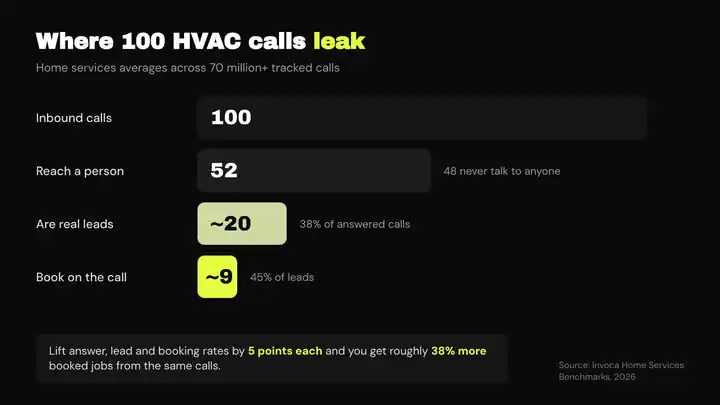
The leak starts at the phone. Invoca’s 2026 Home Services Lead Conversion Benchmarks, drawn from a dataset of more than 70 million calls, found only 52% of calls to home services businesses are answered by a person. Below is how we build a recovery system for HVAC companies: what counts as a missed lead, the workflow for each type, and how to prove the money it brings back.
Missed HVAC leads by the numbers
| Statistic | Why an HVAC owner should care | Source + year |
|---|---|---|
| 52% of calls to home services businesses are answered by a person | Close to half of inbound callers never speak to anyone on the first try | Invoca Home Services Benchmarks, 2026 |
| 45% of leads on answered calls convert on that call | Even a connected caller leaves without a booking more often than not | Invoca, 2026 |
| Lifting answer, lead and conversion rates 5 points each gives roughly 38% more conversions | Small fixes at each leak add up to a large gain on the same call volume | Invoca, 2026 |
| 66% of consumers have hung up after being on hold too long | Hold queues in a heat wave create hang-ups you never see as missed calls | Invoca Home Services Buyer Experience Report, cited by Invoca, 2026 |
| $127.74 median cost per lead for AC installation and repair search ads; $129.02 for heating and furnaces | Every dropped lead is money already spent | LocaliQ Home Services Search Ad Benchmarks, 2025 |
| 51.71% form conversion rate across about 93 million sessions in all sectors | Roughly half the people who open a form never send it | Zuko form benchmarking, 2025 |
| $1.8 million in revenue year to date from one text sent on day 10 of an unsold estimate | Quotes that went quiet are often the biggest pile of recoverable revenue | ServiceTitan, 2026 |
What counts as a missed lead in an HVAC business?
Most owners picture a call that rang out. In our audits that is one of five leaks, and rarely the most expensive.
- Unanswered calls, including calls that hit voicemail or an after-hours greeting.
- Hang-ups on hold, which show up in the phone log as short answered calls, not misses.
- Half-filled web forms where the visitor typed a phone number or email and left.
- Unsold estimates for replacements, ductwork or indoor air quality add-ons.
- Leads marked “lost” or “not ready” months ago that nobody has contacted since.
Missed calls now cost you twice on Google
If you run Local Services Ads, Google’s How leads work page says a call you miss during business hours is a valid, chargeable lead when the caller stays on the line for more than 20 seconds. Voicemail during business hours is charged after 20 seconds too, message or not. ServiceTitan reported the change took effect on 1 October 2026. A caller who gives up on your voicemail is a lead you paid for and dropped.
The ones nobody counts
Abandoned forms and stale estimates never trigger an alert. Zuko’s 2025 benchmarks put form conversion at 51.71% across all sectors. If 40 people a month start your “request service” form, around 19 of them leave partway. When the phone field comes before the address field, you still have a number to text.
How to build an HVAC missed lead recovery system
We usually build HVAC missed lead recovery on GoHighLevel beside ServiceTitan, Housecall Pro or Jobber, but any CRM that can fire a workflow from a call status, form event or pipeline stage works. If you have not set up first contact yet, read our post on AI for missed HVAC calls first. Recovery catches what first contact drops.
Step 1: Give every leak a status the CRM can see
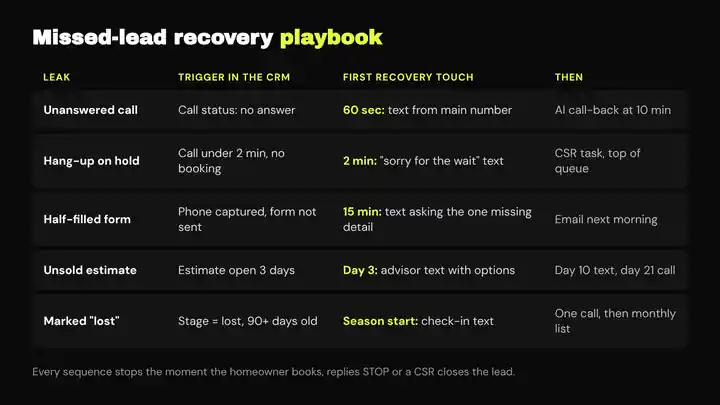
A workflow can only act on what it can detect, so we create one tag per leak: “no answer”, “hold drop”, “partial form”, “estimate open” and “lost, revisit”. Call tracking sets the first two from call outcome and duration. A form tool that saves partial entries, or a short script on the page, sends the third the moment a phone number is typed. The estimate and lost tags come from your field service software through a native integration, a webhook or an n8n workflow.
Step 2: Recover live calls inside ten minutes
For an unanswered call, a missed call text back goes out within a minute from your main number, signed by your dispatcher. With no reply in ten minutes, an AI voice agent calls back, says it is the company’s assistant, asks what the system is doing and offers two open slots. Hold drops get a different message (“Sorry you had to wait. Want us to call you right back?”) and jump to the top of the CSR queue. Invoca reports 66% of consumers have hung up after waiting on hold too long, so these callers rarely try a third time.
Step 3: Ask partial form leads one question
Don’t send the form back. Fifteen minutes later, text a question about only what is missing: “Saw you started a service request. What’s the address, and is the unit running at all?” An AI chatbot handles the reply, books the visit and writes the answers into the contact record. With only an email, send one short note the next morning. Collect SMS consent on the form itself, since US business texting falls under TCPA rules and A2P 10DLC registration.
Step 4: Work unsold estimates on a schedule
Replacement quotes are where recovery pays the most. ServiceTitan’s April 2026 article on automating follow-ups on unsold estimates describes Cooper Heating Cooling Plumbing and Electrical earning $1.8 million year to date from a single text triggered on day 10 of an open estimate. The same article reports Above + Beyond Service Co. recovering $1 million in 2024 from estimates that would otherwise have gone cold. Treat these vendor case studies as the top of the range.
Our default cadence: day 3, a text from the comfort advisor with the good, better and best options restated in two lines. Day 10, a text that answers the most common objection for that quote, such as financing or install timing. Day 21, a call task for the advisor. AI drafts each message from the estimate notes; the advisor approves the first one.
Step 5: Reopen lost leads at the start of each season
Leads tagged “lost, revisit” and older than 90 days get one check-in when the season turns: cooling leads in late spring, heating leads in early fall. One text, an AI call if they reply, then a monthly email list. Anyone who replies STOP leaves every sequence. Our GoHighLevel guide for HVAC companies shows how to set up the seasonal triggers.
How do you measure recovered revenue?
When a contact with any leak tag books, the CRM adds a “recovered” tag. Every Monday we report three numbers:
- Leads recovered by leak type, as a share of all leads with that tag
- Revenue from invoices tied to recovered contacts, pulled back from your field service software
- Lead spend saved, using your own cost per lead
The third number is the easy sell. LocaliQ’s home services benchmarks, built from 3,211 US search campaigns, put the median cost per lead at $127.74 for AC installation and repair. Twenty recovered AC leads a month is about $2,550 of ad spend you do not have to buy again, before you count a single job.
Where missed-lead recovery goes wrong
- Recovering leads that already booked. If the CRM does not get booked jobs back from dispatch, a customer on the schedule for tomorrow gets a “we missed you” text tonight.
- One message for every leak. A hold drop, a partial form and a stale estimate need different words. A generic “just checking in” gets ignored by all three.
- Letting AI rewrite prices. The day 10 estimate text can restate the advisor’s numbers; it should never invent a discount.
- No emergency path. A recovered caller who says there is no heat and a newborn in the house needs your on-call tech, not a slot on Thursday.
Frequently asked questions
How is missed-lead recovery different from speed to lead?
Speed to lead is how fast you make first contact with a new inquiry. Missed-lead recovery handles what first contact dropped: unanswered calls, hold hang-ups, partial forms, unsold estimates and old lost leads. You need both. Our post on automating speed to lead for home-service companies covers first contact in detail.
Am I charged for missed Local Services Ads calls?
Often, yes. Google says a call missed during your business hours counts as a valid lead if the caller stays on the line for more than 20 seconds, and calls that go to voicemail are charged after 20 seconds too. Fast recovery turns that charge into a booked job.
When should I stop following up on an unsold HVAC estimate?
After about three weeks of active follow-up, move it to a seasonal list. We use texts on day 3 and day 10 and an advisor call on day 21. ServiceTitan reports one contractor earned $1.8 million year to date from a single day 10 text, so the second touch matters more than most teams expect.
Can I recover partial form leads without being intrusive?
Yes, if you collected consent and keep it to one useful message. Put the SMS consent line next to the phone field, then send a single text asking for the missing detail, not a sales pitch. If there is no reply, send one email the next day and stop. People who wanted help usually answer the first text.
Run a 30-day leak count first
Pull last month’s call log, form starts and open estimates, count each of the five leaks and multiply by your cost per lead. That number shows which HVAC missed lead recovery workflow to build first and gives you a baseline. For the sequences that run after a lead is recovered, see our guide to AI lead follow-up for HVAC companies.
Cubikey builds this system for HVAC companies: leak tagging, missed call text back, AI voice and chat recovery, estimate cadences, seasonal reactivation and the revenue report tied to your field service software. See what our AI automation service covers, then send us your leak count. Talk to Cubikey.
Sources
- Invoca: 2026 Home Services Benchmarks report (July 2026)
- Invoca: Why most home services brands pay to generate demand they never convert (August 2026)
- Google Local Services Help: How leads work
- ServiceTitan: The Google LSA change every contractor needs to know about (September 2026)
- ServiceTitan: Automation for follow-ups can save millions (April 2026)
- LocaliQ: Search ad benchmarks for home services (2025, updated July 2026)
- Zuko: Form abandonment data by industry sector (2025)