May 21, 2026
Agentic AI vs Generative AI in AI-Powered Customer Experiences
Agentic AI vs Generative AI: What’s the Difference?
This question is becoming increasingly important as businesses adopt smarter automation tools to improve customer experiences, marketing performance, and operational efficiency. While both technologies belong to the artificial intelligence ecosystem, they solve very different problems.
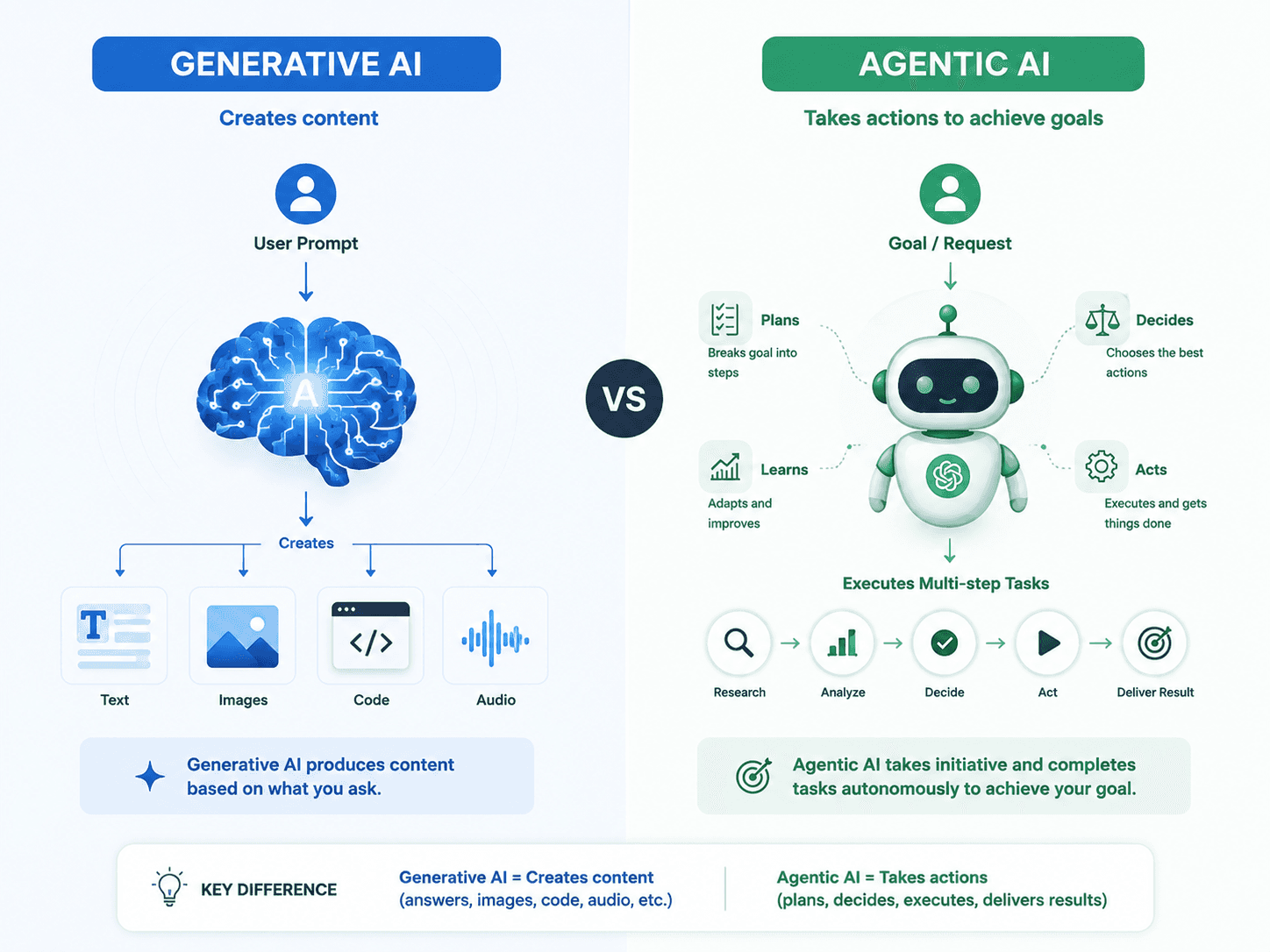
Generative AI focuses on creating content such as text, images, videos, and code. Agentic AI, on the other hand, is designed to make decisions, complete tasks autonomously, and optimize workflows with minimal human involvement.
As companies invest more heavily in AI agents for personalization, AI customer journey automation, and AI content personalization, understanding the distinction between these AI systems becomes critical. Businesses that choose the right AI strategy can deliver faster support, highly personalized experiences, and scalable marketing automation.
This guide explains the differences between Agentic AI and Generative AI, how they work, and why they matter for modern customer experience strategies.
What Is Generative AI?
Generative AI is a type of artificial intelligence that creates new content using patterns learned from large datasets. It can generate:
Articles
Emails
Images
Videos
Music
Computer code
Popular AI tools such as chatbots and AI writing assistants are examples of Generative AI systems.
How Generative AI Works
Generative AI models are trained using massive amounts of data. These systems identify patterns and predict the most likely output based on user prompts.
For example:
A text model predicts the next word in a sentence
An image model predicts visual patterns
A coding model predicts programming structures
Most Generative AI tools rely heavily on:
Machine learning
Neural networks
Natural language processing (NLP)
Transformer models
These systems are highly creative but usually require user instructions to function effectively.
Common Applications of Generative AI
Generative AI is widely used across industries because it improves productivity and accelerates content creation.
Marketing and Content Creation
Businesses use Generative AI for:
Blog writing
Email campaigns
Ad copy
Social media captions
Graphic Design
AI-generated visuals are now common in:
Branding
Advertising
Website design
Video production
Software Development
Developers use AI to:
Generate code
Debug applications
Create technical documentation
Customer Support
Many organizations use Generative AI chatbots to answer frequently asked questions and improve customer engagement.
However, these systems generally do not operate independently. They still depend on prompts and human oversight.
What Is Agentic AI?
Agentic AI is an advanced form of artificial intelligence designed to act autonomously and complete objectives without constant human input. Unlike Generative AI, which mainly creates content, Agentic AI focuses on:
Decision-making
Planning
Problem-solving
Workflow execution
Goal completion
An AI agent behaves more like a digital employee than a content generator. For example, an Agentic AI system handling customer service may:
Detect customer frustration
Access purchase history
Recommend solutions
Escalate issues automatically
Follow up after resolution
This makes Agentic AI highly valuable for AI customer journey automation and operational optimization.
Core Features of Agentic AI
Agentic AI systems include several advanced capabilities that differentiate them from traditional AI tools.
Feature | Agentic AI Capability |
Autonomy | Operates independently |
Goal Orientation | Pursues business objectives |
Context Memory | Retains long-term information |
Adaptability | Adjusts strategies dynamically |
Decision-Making | Chooses optimal actions |
These systems continuously learn and improve based on outcomes and customer interactions.
How Autonomous AI Agents Operate
AI agents combine multiple technologies to function effectively.
These include:
Machine learning
Real-time analytics
Reinforcement learning
Workflow orchestration
Natural language understanding
Unlike Generative AI tools, Agentic AI systems can complete multi-step tasks without repeated prompts. This is why companies increasingly adopt AI agents for customer experience and intelligent automation systems.
Read More:
GEO (Generative Engine Optimization) Guide
Programmatic SEO for Scalable Organic Growth
Enterprise News SEO in 2026: How to Win Discover, Top Stories & AI Overviews
Agentic AI vs Generative AI: Key Differences
Understanding the difference between these technologies is essential for choosing the right AI strategy.
Aspect | Generative AI | Agentic AI |
Main Purpose | Content creation | Goal execution |
Human Dependency | High | Low to moderate |
Decision-Making | Limited | Advanced |
Context Awareness | Temporary | Persistent |
Workflow Automation | Partial | Full |
Adaptability | Prompt-based | Dynamic |
Autonomy | Minimal | High |
Decision-Making Capabilities
Generative AI responds to prompts provided by users. Agentic AI independently evaluates situations and decides the best course of action.
For example:
Generative AI writes a marketing email.
Agentic AI determines when to send the email, who should receive it, and how to optimize performance.
Goal-Oriented Automation
Agentic AI systems are built around objectives.
Examples include:
Reducing customer churn
Improving sales conversions
Automating customer onboarding
Optimizing marketing performance
The AI agent continuously adapts strategies to achieve these goals.
AI Agents for Personalization in Marketing
Modern customers expect highly personalized experiences across every digital touchpoint.This demand has accelerated the adoption of AI agents for personalization.
Businesses now use AI to:
Customize product recommendations
Deliver targeted promotions
Personalize website experiences
Optimize customer interactions
Behavioral Prediction Systems
AI agents analyze customer behavior patterns to predict future actions.
These systems evaluate:
Browsing history
Purchase behavior
Engagement patterns
Search activity
This allows businesses to deliver highly relevant experiences in real time.
AI Personalization Examples Across Industries
Several industries already rely heavily on AI personalization systems.
Retailers use AI for:
Product recommendations
Dynamic pricing
Personalized search results
Companies like Netflix and Spotify use AI personalization engines to recommend movies, shows, and playlists.
Financial institutions use AI for:
Fraud detection
Personalized financial advice
Risk analysis
These are powerful examples of how businesses use AI agents for personalization at scale.
AI Customer Journey Automation and AI-Driven Customer Journeys
Businesses are increasingly investing in AI customer journey automation to streamline interactions and improve customer experiences. Customer journeys involve multiple stages:
Awareness
Consideration
Purchase
Support
Retention
AI agents can automate and optimize every stage.
How AI Personalizes Customer Journeys
Many businesses ask: “how AI personalizes customer journeys”.The answer lies in continuous data analysis and automation. AI systems analyze:
Customer behavior
Previous interactions
Purchase history
Engagement signals
Using this information, AI delivers personalized experiences automatically.
Examples include:
Product recommendations
Personalized emails
Dynamic website content
Automated support responses
AI Content Personalization and AI Content Workflows
Content marketing has changed dramatically due to artificial intelligence.Today, businesses use AI content personalization to deliver more relevant experiences.
Dynamic Content Personalization
AI systems can personalize:
Website copy
Product descriptions
Email campaigns
Blog recommendations
Every user receives customized content based on their interests and behavior.
AI Content Workflows for Marketing Teams
Modern teams use AI in marketing to automate content production and optimization.
Typical AI content workflows include:
Topic research
Content generation
SEO optimization
Publishing automation
Performance tracking
This improves productivity and scalability significantly.
AI Marketing Personalization Strategies
Businesses using AI marketing personalization often achieve:
Higher engagement rates
Better conversion rates
Improved customer retention
More effective campaigns
Popular personalization strategies include:
Audience segmentation
Predictive targeting
Behavioral analysis
Real-time optimization
What Makes Agentic AI More Advanced Than Generative AI?
Agentic AI represents the next stage of artificial intelligence evolution. While Generative AI focuses mainly on content creation, Agentic AI combines:
Intelligence
Memory
Autonomy
Decision-making
Workflow orchestration
This allows AI agents to function independently in complex environments.
Future Trends in AI Personalization Engines
The future of AI will focus heavily on autonomy and hyper-personalization.
Hyper-Personalized Customer Experiences
AI systems will soon create completely individualized experiences for every customer.
This includes:
Real-time recommendations
Adaptive interfaces
Predictive support
Personalized pricing
Multi-Agent AI Ecosystems
Future businesses may deploy multiple AI agents simultaneously.
Examples include:
Sales agents
Marketing agents
Customer support agents
Analytics agents
These systems will work together autonomously.
Autonomous Marketing Operations
Entire marketing ecosystems may eventually operate independently using interconnected AI systems.
This could transform:
Campaign management
Customer engagement
Data analysis
Content production
Conclusion
Generative AI excels at content creation and creativity. Agentic AI focuses on autonomous execution, intelligent decision-making, and workflow optimization. Together, these technologies are powering:
AI customer journey automation
AI content personalization
AI-driven customer journeys
AI CX automation
AI marketing personalization
Businesses that successfully combine these technologies can deliver faster, smarter, and more personalized customer experiences while improving operational efficiency and scalability.
As AI technology continues evolving, Agentic AI is expected to become a major driver of business automation and customer engagement worldwide.
FAQs
What is the difference between Agentic AI and Generative AI?
Generative AI creates content such as text and images, while Agentic AI autonomously completes tasks and makes decisions to achieve goals.
What are AI agents for content marketing?
AI agents for content marketing are autonomous systems that can plan, create, optimize, schedule, and distribute marketing content automatically.
What are some AI personalization examples?
Examples include:
Product recommendations on e-commerce websites
Personalized playlists on streaming platforms
Dynamic website content
AI-powered email campaigns
What is customer journey automation with AI?
Customer journey automation with AI uses intelligent systems to automate customer interactions, recommendations, support, and marketing across all touchpoints.
What are AI personalization engines?
AI personalization engines are platforms that use machine learning and behavioral analysis to customize customer experiences in real time.